Liquid cooling vs air cooling in the UAE is not a simple case of one technology always being better. A large tower air cooler can handle many gaming processors quietly and reliably, while a quality AIO liquid cooler can provide additional thermal capacity for high-power CPUs and sustained workloads.
Dubai's climate also does not automatically mean every gaming PC requires a 360mm liquid cooler. What matters more is the CPU's actual power behaviour, the temperature of the air entering the case, radiator or heatsink airflow, case ventilation and the workload you run.
This guide compares air coolers and AIO liquid coolers for UAE gaming PCs, including temperature behaviour, noise, maintenance, reliability, case compatibility and which option makes more sense for mainstream, high-end and flagship systems.
Cooling guide • Reviewed October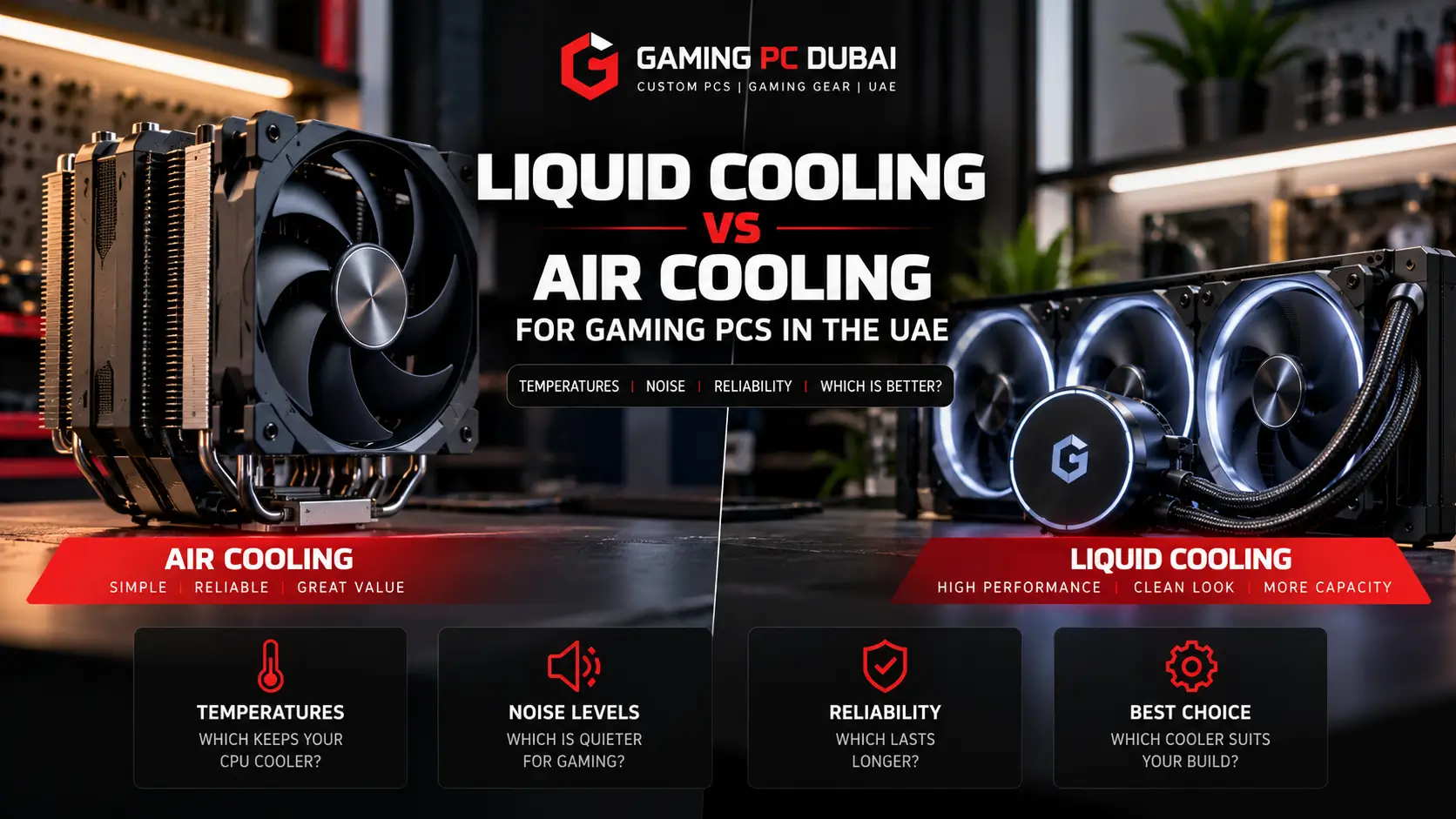
Liquid Cooling vs Air Cooling UAE — Quick Facts
A quality dual-tower air cooler can handle many mainstream and high-performance gaming processors without pumps, tubing or radiator installation.
Large 280mm and 360mm AIO coolers provide more radiator surface area and can be advantageous for high-power CPUs under long sustained workloads.
A radiator can only release heat into the surrounding air. Poor case ventilation or warm recirculated exhaust reduces AIO effectiveness.
Traditional air coolers have no pump. Their main moving parts are replaceable fans, giving them a mechanically simple design.
The compact pump/block leaves more open space around memory modules and motherboard components compared with very large tower heatsinks.
Indoor intake temperature, processor power and chassis airflow matter more than the city name printed on the shipping address.
How Does Air Cooling Work?
A CPU air cooler transfers heat from the processor into a metal cold plate, through heat pipes and into a large fin stack. One or more fans then move room air through those fins to remove the heat.
Modern dual-tower air coolers can provide substantial cooling capacity while remaining mechanically simple.
Advantages of Air Cooling
- No pump to wear out.
- Simple installation on compatible cases.
- Fans are generally easy to replace.
- No liquid circulating inside the cooler.
- Strong value for mainstream gaming processors.
- Good long-term reliability.
Disadvantages of Air Cooling
- Large tower coolers can be physically bulky.
- RAM clearance can become an issue.
- Very large heatsinks can complicate motherboard access.
- Extreme sustained CPU loads may favour a large radiator.
How Does AIO Liquid Cooling Work?
An all-in-one liquid cooler places a pump and cold plate on the CPU. Coolant moves heat through tubing to a radiator, where fans transfer that heat into the case or room air.
Common radiator sizes include 240mm, 280mm and 360mm. Larger radiators provide more surface area, but case compatibility and fan quality remain important.
Advantages of AIO Liquid Cooling
- High thermal capacity with larger radiators.
- Useful for high-power processors under sustained load.
- Cleaner area around the CPU socket.
- Can improve RAM and motherboard access.
- 360mm radiators can spread heat across three fans.
- Often preferred for premium visual builds.
Disadvantages of AIO Liquid Cooling
- Includes a pump as an additional moving component.
- More complicated installation than a basic air cooler.
- Radiator placement affects case airflow.
- Pump noise can be audible at some operating speeds.
- Long-term pump failure requires cooler replacement.
Which Runs Cooler: Liquid Cooling or Air Cooling?
Large AIO coolers generally provide more thermal capacity than smaller air coolers, but the comparison depends heavily on the exact products being compared.
| Cooling Type | Typical Strength | Best Fit |
|---|---|---|
| Single-tower air cooler | Moderate CPU heat loads | Mainstream gaming CPUs |
| Dual-tower air cooler | High air-cooling capacity | Mid-range and many high-end gaming CPUs |
| 240mm AIO | Compact liquid cooling | Gaming CPUs where case layout favours a radiator |
| 280mm AIO | Large radiator surface | High-performance gaming and mixed workloads |
| 360mm AIO | High sustained thermal capacity | Flagship CPUs and heavy CPU workloads |
Is Liquid Cooling Quieter Than Air Cooling?
Not automatically.
An air cooler normally has only one or two fans producing mechanical noise. An AIO may have two or three radiator fans plus a pump.
At moderate CPU loads, a large air cooler can be extremely quiet because the heatsink stores and dissipates heat without requiring aggressive fan speed.
At sustained high CPU power, a large 360mm radiator can distribute the heat across three fans, potentially allowing each fan to run more slowly than a smaller cooler.
- Fan quality affects noise significantly.
- Radiator restriction can require higher fan speeds.
- Pump speed contributes additional AIO noise.
- Fan curves often matter as much as cooler type.
Which Is More Reliable: Air Cooling or Liquid Cooling?
Air cooling has the mechanical simplicity advantage.
The heatsink itself contains no pump and can remain functional for many years. If a fan eventually fails, it can normally be replaced without changing the heatsink.
An AIO adds a pump, sealed coolant loop and tubing. Modern quality AIO coolers are designed for long service life, but pump failure eventually requires replacement of the cooling unit.
Fewer moving parts, straightforward fan replacement and minimal long-term maintenance beyond dust cleaning.
Provides excellent cooling potential but adds a pump and sealed liquid loop that should be considered when planning long-term ownership.
Does Dubai's Climate Make Liquid Cooling Better?
Dubai's climate does not automatically make liquid cooling superior.
Both cooling systems ultimately release processor heat into the surrounding air. An AIO does not refrigerate the CPU; it simply moves heat from the processor to a radiator before transferring it into the air.
If a room is warmer, both air and liquid coolers receive warmer intake air and therefore have less thermal headroom.
A well-air-conditioned room with good case airflow can allow either cooling system to perform effectively.
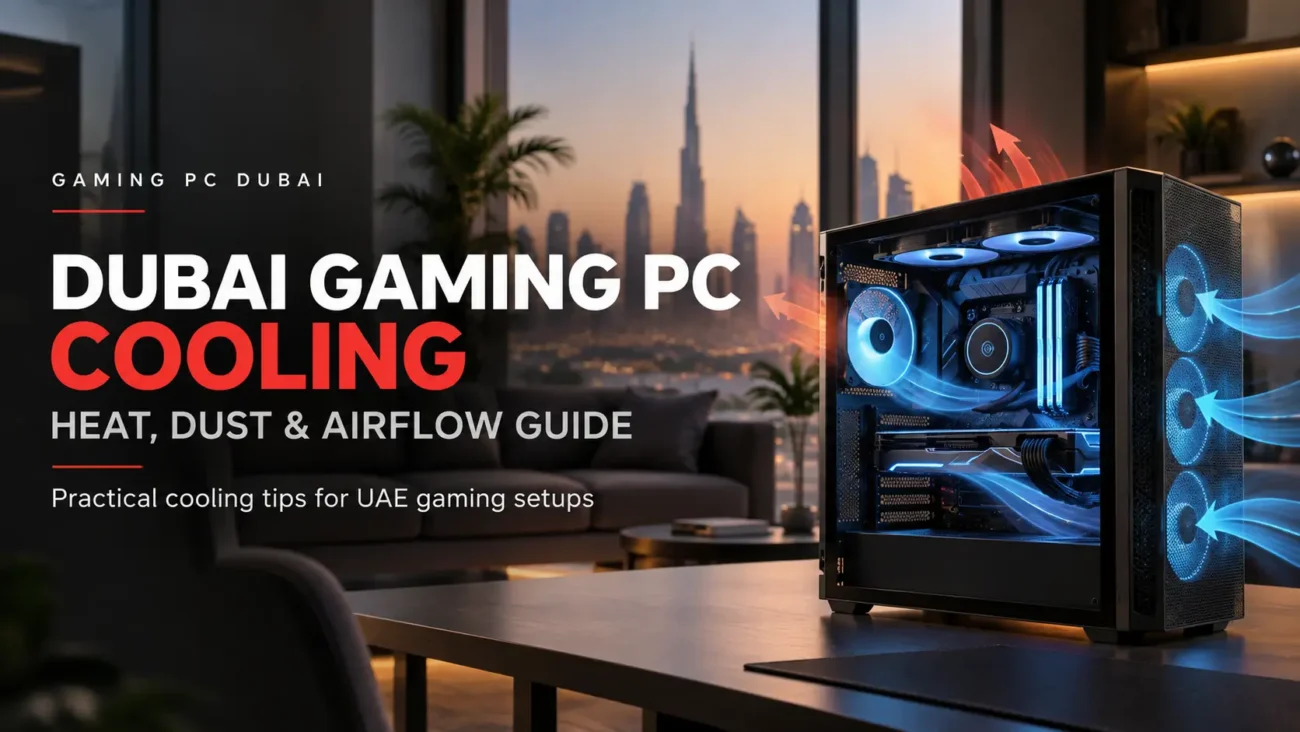
For the broader thermal relationship between room temperature, airflow and dust, read our Gaming PC Cooling in Dubai guide .
Which CPUs Actually Need Liquid Cooling?
The answer depends more on CPU power and workload than the CPU's marketing tier alone.
Many Core i5, Ryzen 5 and efficient gaming processors can operate well with a quality tower air cooler.
Ryzen 7, Core Ultra 7 and similar processors can use either strong air cooling or an AIO depending on power behaviour and workload.
High-power Ryzen 9 and Core Ultra 9 systems often justify a 280mm or 360mm AIO when sustained all-core workloads are expected.
For X3D gaming systems, cooler selection should be based on the exact CPU and case. For example, buyers comparing AMD gaming processors can also read our Ryzen 7 7800X3D vs 9800X3D UAE comparison .
Why Case Airflow Matters More Than Cooler Type
A premium CPU cooler cannot perform properly if the chassis repeatedly feeds it hot air.
- Front or side intake should have sufficient open area.
- Warm exhaust needs a clear rear or top exit.
- Radiators should not be blocked by dense dust buildup.
- GPU exhaust should not continuously recirculate into the CPU cooler.
- Bottom intakes should remain unobstructed.
- Closed cabinets can trap the PC's own exhaust air.
The complete thermal design should consider the CPU cooler, graphics card and chassis as one system rather than three unrelated components.
Should You Choose Air Cooling or Liquid Cooling in the UAE?
Choose Air Cooling If:
- You use a mainstream or moderately powered CPU.
- You prioritize mechanical simplicity.
- You want easy long-term maintenance.
- Your case fits a large tower heatsink.
- You prefer lower initial cost.
- You do not run sustained heavy CPU workloads.
Choose Liquid Cooling If:
- You use a high-power flagship CPU.
- You run rendering or long CPU-intensive workloads.
- You want additional sustained thermal capacity.
- Your case supports a large radiator properly.
- You want more clearance around the CPU socket.
- You prefer the appearance of a premium AIO build.
Gaming PC Dubai selects the cooler based on the complete configuration rather than automatically installing liquid cooling in every expensive PC.
Liquid Cooling vs Air Cooling UAE — Frequently Asked Questions
Is liquid cooling better than air cooling for gaming?
Not necessarily. A quality air cooler can handle many gaming CPUs very effectively. Liquid cooling becomes more useful with high-power processors, sustained CPU workloads or cases where radiator placement is preferable.
Do I need liquid cooling for a gaming PC in Dubai?
No. Dubai's climate does not automatically require liquid cooling. CPU power, indoor intake temperature, case airflow and workload determine whether an AIO is worthwhile.
Is a 360mm AIO better than an air cooler?
A good 360mm AIO generally offers greater sustained thermal capacity than typical air coolers, but it also costs more and includes a pump. The extra capacity may provide little practical gaming benefit on a low-power CPU.
Can an air cooler handle Ryzen 7 gaming CPUs?
Many Ryzen 7 processors can run effectively with a capable tower air cooler. The correct choice depends on the specific processor, power settings and sustained workload.
Does liquid cooling need maintenance?
A sealed AIO does not normally require users to refill coolant. It still requires radiator and fan cleaning, and the pump should be monitored for abnormal noise or failure.
Which cooler lasts longer?
A traditional air cooler can have a very long service life because the heatsink itself has no pump. Fans can usually be replaced separately if they wear out.
Is liquid cooling quieter?
It can be, particularly during sustained high CPU loads with a large radiator, but an AIO also adds pump noise. A large air cooler with a well-tuned fan curve can be extremely quiet.
What cooler should I use for a high-end gaming PC?
Use a cooler matched to the exact CPU, chassis and workload. Strong tower air cooling suits many gaming systems, while 280mm or 360mm AIOs are more appropriate for high-power CPUs and sustained heavy workloads.
Liquid Cooling vs Air Cooling UAE: Final Verdict
For most gaming PCs, a high-quality air cooler remains a reliable and cost-effective choice. A large AIO becomes more valuable when the processor produces substantial sustained heat or when the build benefits from additional radiator capacity and CPU-socket clearance.
Dubai's climate should influence the overall airflow design and room conditions, not force every buyer toward liquid cooling.
The best cooling system is the one sized correctly for the processor, installed in a ventilated chassis and tested under sustained real-world load.
Choose the Right Cooling for Your Gaming PC
Gaming PC Dubai configures CPU cooling around the actual processor, graphics card, case airflow and workload rather than using one cooler for every build. Completed systems include 24-hour thermal stress testing, 1–2 year local UAE warranty options, eligible Tabby/Tamara 0% installment options and free doorstep delivery across all seven Emirates.